Based on size and functionality, there are four main types of data center:
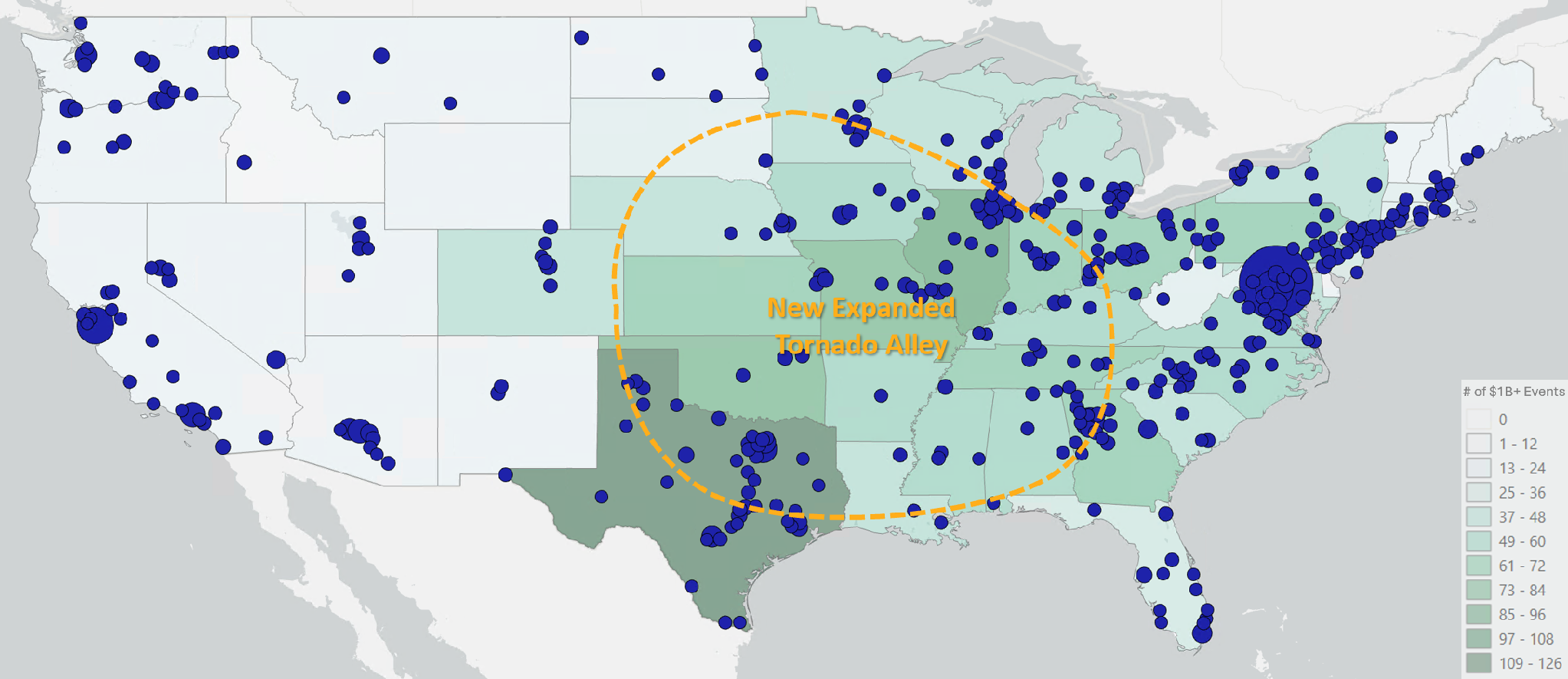
We see a construction pattern emerging – States with meaningful storm exposure (Texas, Virginia, Georgia, Ohio) now also have significant clusters (accumulations) of data centers.
Due to their consumption of local water and electricity, these clusters are already a sensitive political issue in their local communities. Now re/insurers are concerned about their high value and sensitivity to disruption of said water/electricity supplies. A dense concentration of electrical and cooling equipment, and an aversion to downtime makes a data center risk profile more similar to a nuclear power plant than a standard commercial property.
The problem isn’t just how valuable these buildings are. It is where they are. Over 80% of long-term severe convective storm loss trend is tied to growth in exposure i.e. valuable assets are being built in exposed areas. The other issue is the expansion of ‘Tornado Alley’.
We took NOAA’s frequency map of $1B+ (CPI adjusted) severe convective storms from 1980-2024 and overlaid our own database of data centers (hyperscalers are red). It is clear that ‘New Tornado Alley’ includes several fast-growing clusters:
Sources: NOAA, TransRe
Because data centers are designed for continuous uptime, even limited physical damage (wind and hail, heavy rainfall, localized flooding) can cause significant business disruption.
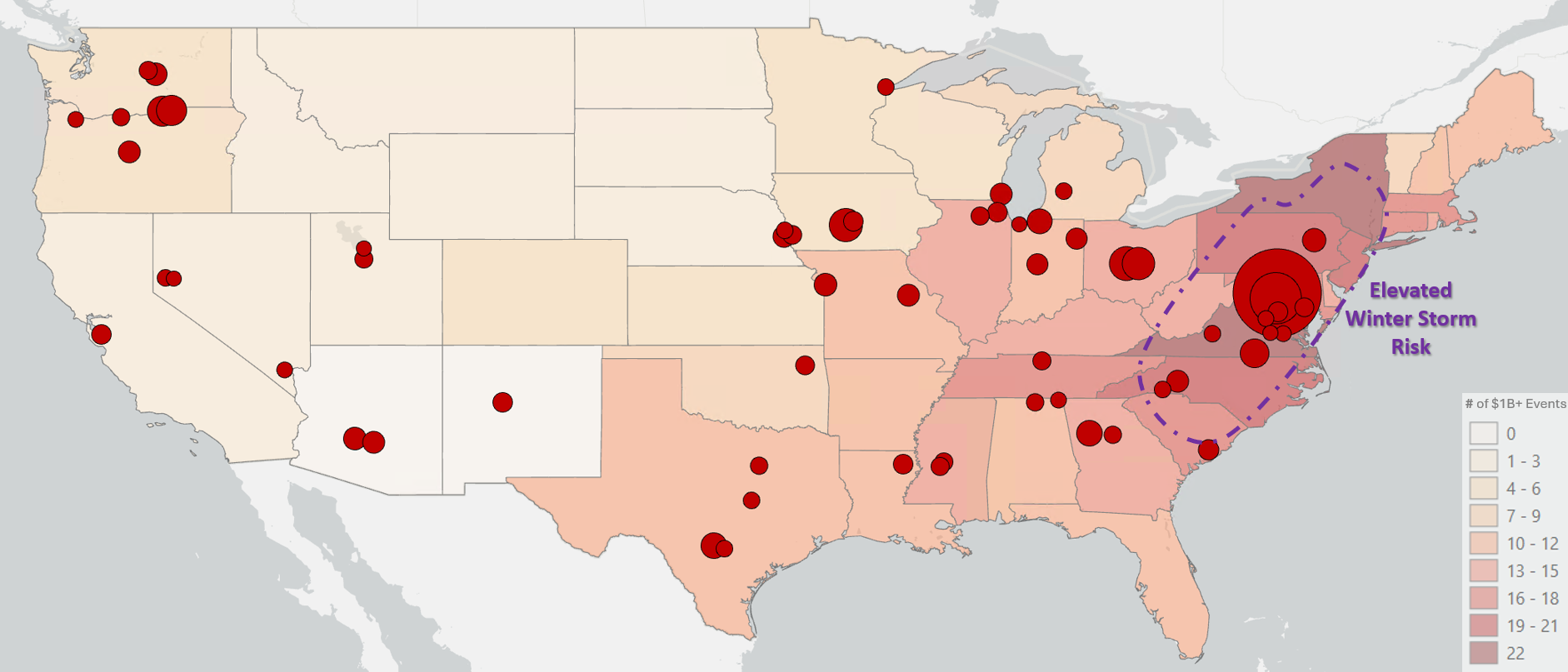
A big concern is the instability of power supply, especially in Texas where much of the state operates on an isolated grid with limited ties to the broader U.S. network. Texas has updated its weatherization/building codes and improved power generation/storage since Winter Storm Uri (2021) caused widespread blackouts, but the exposure remains elevated.
We took NOAA’s frequency map of $1B+ (CPI adjusted) winter storms from 1980-2024 and overlaid our own data base of hyperscale data centers:
Sources: NOAA, TransRe
Virginia shares the Eastern Interconnection, so disruptions to electricity supplies may start upstream (fuel supply, generation, transmission), especially during weather events when electric grids are under considerable strain. This risk is heightened by Virginia’s relatively frequent winter storms, which can drive outages and place additional stress on an already constrained grid.
Local community protests are changing the political environment. So far three states (California, Utah and Ohio) have passed legislation increasing the burden on data center developers, by requiring them to pay for the additional infrastructure needed (including new generation and grid upgrades). Currently 27 other states are considering similar changes. Developers making site location decisions are weighing local politics as part of the process.
For re/insurers, the question is no longer whether an individual site is engineered well enough for local weather conditions. That still matters, but it is only part of the picture. A portfolio perspective is required – Where are values clustering? What infrastructure dependencies are shared? How exposed are those dependencies to storm activity? Underwriters learned some tough accumulation lessons from car manufacturing in 2011 (Thai floods) and 2013 (German hail). Those lessons are applicable to data centers, to ensure pricing and accumulation management reflect the potential for both property and interruption loss.
Please contact Haley Sisk, Research Analyst with any questions or comments on this topic.
Reproduction in any form without permission of TransRe is prohibited.
The material and conclusions contained in this document are for information purposes only and TransRe offers no guarantee for the completeness of its contents.
Statements in this document may provide current expectations of future events based on certain assumptions. These statements involve known and unknown risks, uncertainties and other factors which are not exhaustive. Although TransRe makes reasonable efforts to obtain information from reliable sources, TransRe does not guarantee the accuracy or completeness of the information given or any forward-looking statements made.
TransRe undertakes no obligations to revise or update any statements, whether as a result of new information, future events or otherwise, and in no event shall TransRe or any of its affiliates or employees be liable for any damage or loss arising in connection with the use of the information relating to this document.
The Best’s Company Report(s) reproduced on this site appear under license from A.M. Best and do not constitute, either expressly or implied, an endorsement of (Licensee)’s products or services. A.M. Best is not responsible for transcription errors made in presenting Best’s Company Reports. Best’s Company Reports are copyright © A.M. Best Company and may not be reproduced or distributed without the express written permission of A.M. Best Company. Visitors to this web site are authorized to print a single copy of the Best’s Company Report(s) displayed here for their own personal use. Any other printing, copying or distribution is strictly prohibited.
Best’s Ratings are under continuous review and subject to change and/or affirmation. To confirm the current rating, please visit the AM Best web site, www.ambest.com.