Skip to content
  • Home
  • What We Do
    • What We Do
    • Treaty
      • Accident & Health
      • Agriculture / Crop
      • Aviation & Marine
      • Cyber
      • Energy
      • Engineering
      • Entertainment & Contingency
      • Financial Guaranty
      • Traditional Casualty
      • Management & Professional Liability
      • Medical Professional Liability
      • Mortgage Indemnity
      • Property
      • Surety, Trade Credit & Political Risk
      • Terrorism
    • Facultative
    • TransRe Applied Data
    • Insurtech Partners
    • Mortgage Partners
    • Blue Marble Microinsurance
  • About Us
    • About us
    • History
    • Leadership
    • Financial Information
    • Press Releases
    • Social Conscience
      • Social Conscience
      • Global Volunteerism
      • National Coastal Resilience Fund
  • Contact Us
    • Office Locations
    • Regional Business Units
    • Global Portfolio Management
  • Insights
  • Events
  • Legal
  • Careers
menu

Close
  • Home
  • What We Do
    • Lines Of Business
      • Lines of Business
      • TREATY
        • Accident & Health
        • Agriculture / Crop
        • Aviation & Marine
        • Cyber
        • Energy
        • Engineering
        • Entertainment & Contingency
        • Financial Guaranty
        • Traditional Casualty
        • Management & Professional Liability
        • Medical Professional Liability
        • Mortgage Indemnity
        • Property
        • Surety, Trade Credit & Political Risk
        • Terrorism
      • FACULTATIVE
        • Engineering
        • Entertainment & Contingency
        • Management & Professional Liability
        • Medical Professional Liability
        • Property
        • Traditional Casualty
    • TransRe Applied Data
    • Insurtech Partners
    • Mortgage Partners
    • Blue Marble Microinsurance
  • About us
    • About Us
    • History
    • Leadership
    • Financials
      • Financial Highlights
      • Financial Highlights: Tokyo
      • Ratings
      • FATCA Compliance
      • Solvency and Financial Condition Reports
    • Press Releases
    • Social Conscience
      • Social Conscience
      • Research & Resilience
      • Global Volunteerism
      • National Coastal Resilience Fund
  • Contact Us
    • Office Locations
    • Regional Business Units
    • Global Portfolio Management
  • Insights
  • Events
  • Legal
  • Careers
banner

Beyond Fault Boundaries

Cascading Ruptures, in Japan and Venezuela

October 2026

Share
(3 Minute Read)

Share this page


Shortly after Venezuela’s earthquakes, we published a research note highlighting how ruptures may cascade through a connected fault system over a very short period of time, and we drew attention to the implications for the San Andreas fault system in California. 

To recap:

  • On June 24, Venezuela experienced a rare and destructive earthquake doublet
  • A 7.2 foreshock was followed 39 seconds later by a 7.5 mainshock. 
  • Both earthquakes originated near the junction of the Boconó and San Sebastián faults
  • Eastward propagation meant the seismic energy was directed towards Caracas. 
  • Stress-transfer models suggest the doublet has also increased stresses on unruptured segments of the San Sebastián fault beneath Caracas, creating the potential for future large earthquakes.

Kumamoto earthquakes in 2016 and 2026 provide additional data points to help understand how rupture and stress can move through a segmented fault network.


Kumamoto April 16, 2016: Fault-Junction Activation

A 6.2 foreshock on the northern Hinagu Fault was followed 28 hours later by a 7.0 mainshock near the fault junction and transferred onto the Futagawa Fault. Seismic and geodetic observations noted migrating seismicity, static stress changes and afterslip between the two events.

  • Both events occurred within a segmented strike-slip fault system.
  • The larger rupture moved through the Hinagu-Futagawa junction.
  • The delay gave neighboring fault segments time to become more stressed before the mainshock


Kumamoto July 28, 2026: Adjacent-Segment Activity

A 6.8 mainshock was followed 41 minutes later by a 6.1 aftershock on another portion of the broader Hinagu fault system, southwest of the main 2016 activity. Although these events are best interpreted as a mainshock-aftershock sequence rather than a doublet, they do demonstrate continued activity within the same regional fault network, suggesting ongoing stress changes within the fault system.
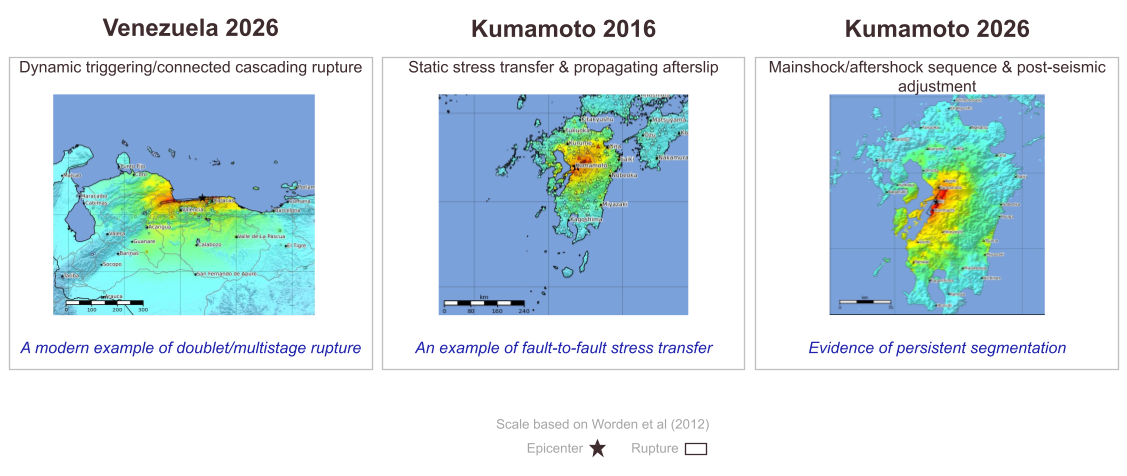
 

Side by Side Comparison

Japan and Venezuela Earthquake Table

Source: USGS (VZ 2026, JP 2016, JP 2026)


What we learned

The three sequences are not identical, but collectively they show why the overall behavior of a connected fault system matters more than any one segment:

  • Connected fault networks can transfer rupture or stress across the boundaries of mapped segments
  • Progressive loading and transfer through a fault junction can occur (Kumamoto 2016)
  • Adjacent parts of a fault network can remain active over longer timescales (Kumamoto 2026)
  • A quick acting sequence makes dynamic triggering or a continuous cascading rupture more relevant than a slower afterslip-driven process. (Venezuela)

Please contact Haley Sisk, Research Analyst  with any questions or comments on this topic.

Legal

Reproduction in any form without permission of TransRe is prohibited.

The material and conclusions contained in this document are for information purposes only and TransRe offers no guarantee for the completeness of its contents.

Statements in this document may provide current expectations of future events based on certain assumptions. These statements involve known and unknown risks, uncertainties and other factors which are not exhaustive. Although TransRe makes reasonable efforts to obtain information from reliable sources, TransRe does not guarantee the accuracy or completeness of the information given or any forward-looking statements made.

TransRe undertakes no obligations to revise or update any statements, whether as a result of new information, future events or otherwise, and in no event shall TransRe or any of its affiliates or employees be liable for any damage or loss arising in connection with the use of the information relating to this document.


TransRe We value risk

TransRe We value risk

TransRe We value risk

  • Home
  • What We Do
  • About Us
  • Contact Us
  • Insights
  • Events
  • Legal
  • Careers
  • PartnersOpens in new window
  • Employees
  • Website Accessibility Statement
  • Opens in new window
    LinkedIn Logo
  • Opens in new window
    Twitter Logo
  • Opens in new window
    Youtube Logo
Do Not Sell or Share My Personal Information
  • Global Privacy Notice
  • Calpe Insurance Privacy Notice
  • Terms & Conditions

© Transatlantic Reinsurance Company

    To


    (Attachment limit 4MB)

    Click here to read the policy. (PDF)

    The Best’s Company Report(s) reproduced on this site appear under license from A.M. Best and do not constitute, either expressly or implied, an endorsement of (Licensee)’s products or services. A.M. Best is not responsible for transcription errors made in presenting Best’s Company Reports. Best’s Company Reports are copyright © A.M. Best Company and may not be reproduced or distributed without the express written permission of A.M. Best Company. Visitors to this web site are authorized to print a single copy of the Best’s Company Report(s) displayed here for their own personal use. Any other printing, copying or distribution is strictly prohibited.

    Best’s Ratings are under continuous review and subject to change and/or affirmation. To confirm the current rating, please visit the AM Best web site, www.ambest.com.

    See Report